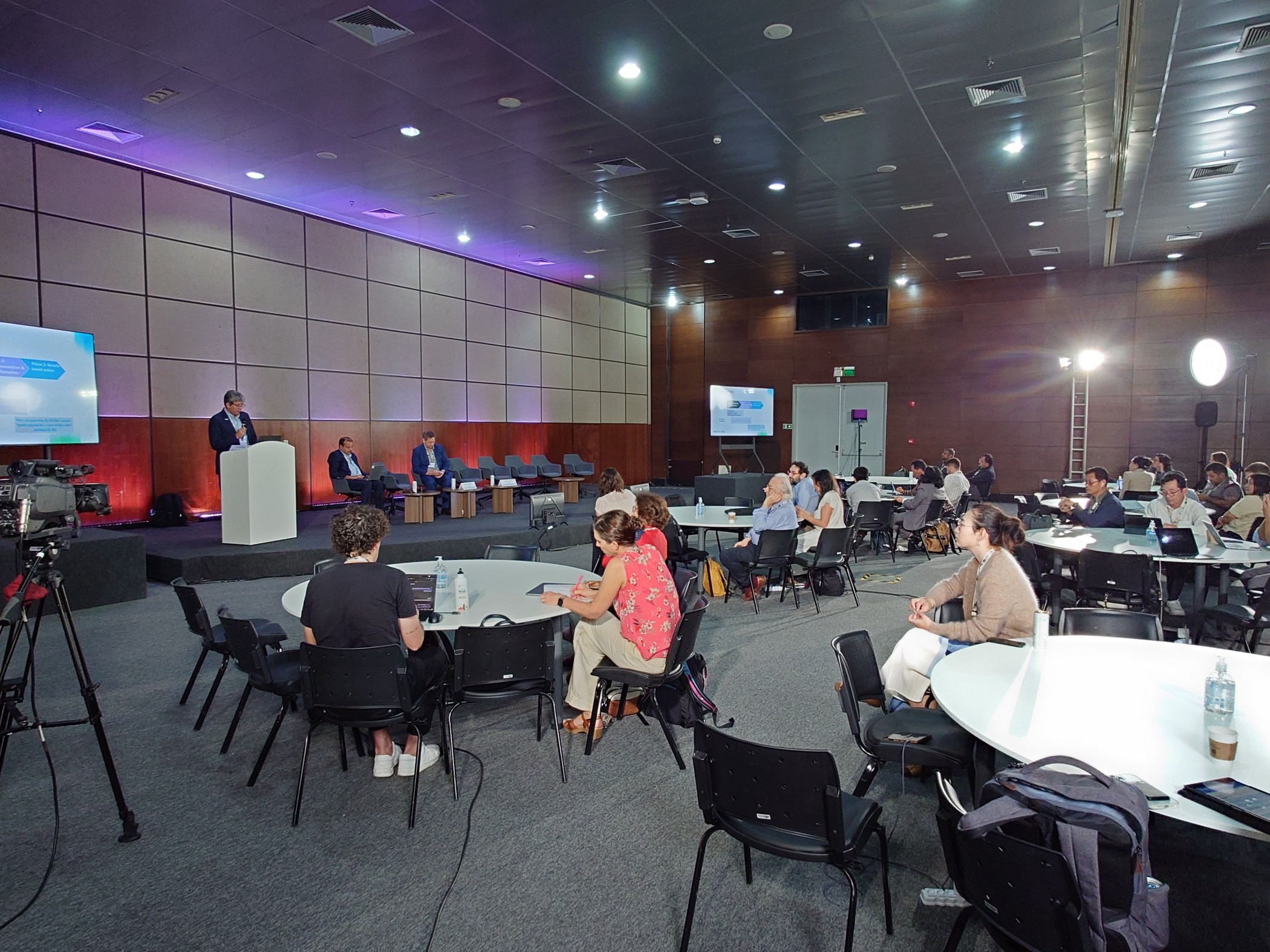
REDD+ side event at COP30: The REDD+ Community of Practice: A Global Mutirão for Forests
This side event built on this spirit of collaboration. It showcased early insights from the REDD+ CP, spotlighted how forests were integrated into the updated NDCs, and explored ways to enhance REDD+ cooperation and financing across platforms. Ultimately, it aimed to foster a shared vision on how UNFCCC and partners could best support countries in achieving the global goal of halting and reversing deforestation and forest degradation by 2030.
November 18, 2025
Background: The outcome of the first Global Stocktake (GST), adopted at COP28, reaffirmed that halting and reversing deforestation and forest degradation by 2030 is essential to keeping the goals of the Paris Agreement within reach. Forest – responsible for both substantial carbon storage and major emission reductions – remain at the centre of global mitigation efforts under Article 5 of the Paris Agreement. As Parties gather at COP30, forests are once again in the spotlight, with many countries integrating stronger forest-related targets and actions in their updated nationally determined contributions (NDCs), informed by lessons learned from over a decade of REDD+ implementation. NDC synthesis report 20251 covering 64 updated NDCs highlighted that international collaboration and REDD+ results-based payments are key to mitigation in the forest sector.
At COP30, renewed attention was also being directed toward mobilizing support for forest climate action. The operationalization of the Enhanced Transparency Framework was enabling countries to report and review progress in a more consistent and transparent manner, including through the in-country technical analysis of REDD+ results. The new permanent policy on REDD+ results-based payments adopted by the Green Climate Fund (GCF) and the ongoing work under Article 6, and emerging climate finance models such as the Tropical Forest Forever Facility collectively broaden the landscape of financing opportunities for countries pursuing forest-based mitigation. For many developing countries with high deforestation rates, REDD+ serves as a critical enabler – providing a framework to demonstrate measurable results, strengthen national systems, and access results-based finance.
In response to this need, the UNFCCC secretariat launched the REDD+ Community of Practice (REDD+ CP) in June – a hybrid platform designed to facilitate technical exchange, peer learning, and collaboration among all REDD+ countries and stakeholders. The REDD+ CP serves as a global knowledge hub where countries and partners can share practical experiences and lessons learned, discuss common challenges, and strengthen collective capacity to implement and report on REDD+ activities.
This side event built on this spirit of collaboration. It showcased early insights from the REDD+ CP, spotlight how forests were integrated into the updated NDCs, and explored ways to enhance REDD+ cooperation and financing across platforms. Ultimately, it aimed to foster a shared vision on how UNFCCC and partners could best support countries in achieving the global goal of halting and reversing deforestation and forest degradation by 2030.
Objectives: In order to strengthen cooperation and collective understanding on REDD+ implementation, this event aimed to:
- Spotlight the role of forests and REDD+ in updated NDCs and in achieving the 2030 goal of halting and reversing deforestation and forest degradation;
- Showcase insights and early lessons emerging from the REDD+ Community of Practice, emphasizing the value of peer exchange and South-South collaboration;
- Highlight experiences and perspectives on implementing REDD+ activities, accessing results-based payments, and addressing remaining challenges, to inform future collaboration and support under REDD+ CP;
- Discuss evolving financing options for REDD+ results-based payments to help countries identify pathways to scale up results-based actions.
Impact and outcomes of the event: Participants gained a clearer understanding of the current landscape of REDD+ implementation, support, and cooperation opportunities. The event helped identify priority areas where knowledge exchange and coordination could strengthen national capacities to implement and report on REDD+, while ensuring consistency and transparency across REDD+ CP. By highlighting real-world examples and collaborative experiences, the event reinforced the importance of a shared vision for UNFCCC support to countries and provide direction for the continued development of the REDD+ CP as a space for global cooperation – a true mutirão for forest.
Target audience:
- Parties implementing or supporting REDD+ activities;
- Technical experts and practitioners involved in REDD+ reporting, financing, or capacity-building;
- International organizations and partner agencies providing technical or financial support for REDD+ implementation;
- Civil society organizations, academia, and other stakeholders engaged in forest and climate action.
Time/Location: Tuesday, 18 November, 11.00–12.30, Special Event Room Paraná (first floor in area C of the COP30 Blue Zone)
Panelists:
- Haruni Krisnawati, Senior Advisor to the Minister for Climate Change, Ministry of Forestry, Indonesia
- Maggie Charnley, Head of International Forests Unit, United Kingdom
- José Carlos Fernandez Ugalde, former REDD+ negotiator, BC3
Agenda:
| TIME | Agenda |
|---|---|
| 11:00-11:05 | Opening remarks by Xuehong Wang, Director of the Transparency Division, UN Climate Change |
| 11:05-11:15 | The role of REDD+ in NDCs and Article 6 (Presentation on NDCs / Presentation on Article 6) UN Climate Change |
| 11:05-11:20 | New GCF REDD+ Results-based Payments (Presentation) Oscar Garcia, Director of Monitoring, Evaluation and Learning, Green Climate Fund |
| 11:20-11:30 | Key insights from UNEP’s State of Finance for Forests 2025 report (Presentation) Mirey Atallah, Chief of the Adaptation and Resilience Branch, Climate Change Division, UN Environment Programme |
| 11:30-11:45 | Q&A 1 |
| 11:45-12:10 | Panel discussion REDD+ experiences and the role of a REDD+ Community of Practice |
| 12:10-12:25 | Q&A 2 |
| 12:25-12:30 | Closing remarks |
Related resources: Explore the REDD+ knowledge products for additional resources, guidance and materials on REDD+ implementation.